

There is no single “best” AI tool for digital marketing — only the best tool for the task in front of you. The tool that drafts a blog post will not design your Diwali sale creative, and the tool that edits your reel will not fix your Google rankings. That is why this guide to ai tools for digital marketing is organised the way marketers actually work: by task — content, SEO, design, video, social media, ads, email, WhatsApp, automation and analytics — with an honest note on what each tool really costs, because “free” on the internet often means “free trial”.
Quick verdict: If you do a bit of everything — as most students, freelancers and in-house marketers in India do — start with ChatGPT for thinking and drafting, Canva for design, and Google’s free tools for research and measurement. Add specialist paid tools only when a task starts eating your week.
How We Grouped These Tools (and an Honest Note on Pricing)
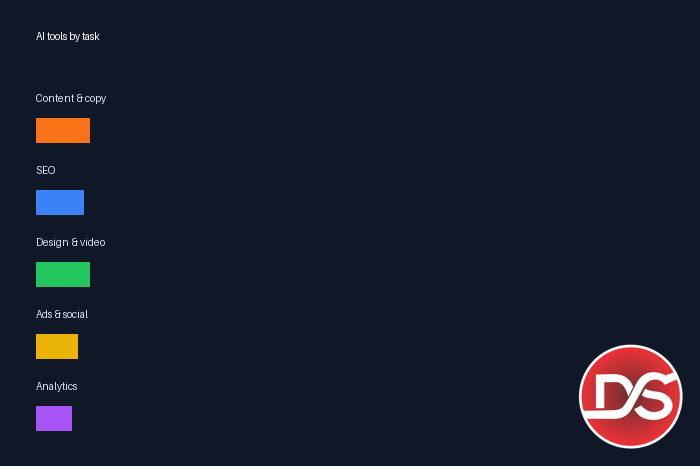
Most listicles group AI tools by vendor category — “writing tools”, “SEO platforms”, “all-in-one suites”. That is how software is sold, not how marketing is done. A marketer’s day is a chain of tasks: research a topic, draft content, optimise it, design a creative, cut a reel, schedule posts, launch an ad, send a WhatsApp broadcast, and report what worked. This guide follows the tasks, in roughly that order:
- Content & copywriting — blogs, ad copy, captions, scripts
- SEO — keyword research, audits, on-page optimisation
- Design & images — creatives, banners, product visuals
- Video — reels, shorts, avatar videos, ad films
- Social media — scheduling, captions, repurposing
- Ads — ad creative and AI-driven campaign automation
- Email, automation & WhatsApp — campaigns, workflows, broadcasts
- Analytics & research — reporting, insights, competitor tracking
Now the pricing honesty part. Published comparisons frequently contradict each other — the same tool appears at three different starting prices on three review sites, because vendors change plans often and reviewers update slowly. So prices here are reported approximations, and the only pricing facts we state firmly are the ones multiple sources agree on: Semrush, Jasper and ActiveCampaign have no free tier at all (only short trials, which is a different thing), while Canva, Copy.ai, Zapier and Perplexity have genuinely usable free tiers. Confirm any price on the tool’s official website before paying. Note also that most international tools bill in USD; a few India-focused tools bill in INR, and we flag those where relevant.
AI Tools for Content & Copywriting
Content is where most marketers meet AI first. The real differentiator is not which tool writes — it is how well you brief it and edit afterwards.
ChatGPT
ChatGPT is the general-purpose assistant most marketers open every day: ideation, outlines, first drafts, ad copy variations, subject lines, scripts, repurposing one blog post into ten social posts. Its free tier is genuinely useful, and the paid plan — reported at around $20/month in published comparisons — adds higher limits and newer models. Best for: everyone, as the default starting point. Its weakness is its strength: it knows a little about everything, so raw output is generic until you feed it your brand voice, audience and examples. Treat it as a fast junior writer, not a publisher.
Google Gemini
Gemini is Google’s AI assistant and a practical companion to ChatGPT, especially for marketers inside Google Workspace — handy for research-flavoured drafting and summarising documents. Its free tier makes it an easy second opinion: draft in one assistant, sanity-check facts or tone in the other. Best for: a free drafting and research assistant alongside your Google tools.
Jasper
Jasper is built specifically for marketing teams: brand voice controls, campaign templates, and workflows for on-brand content at volume. It is paid-only with no free tier — just a short trial — and comparisons disagree widely on its starting price (roughly $40 to $59/month across sources, so check the official site). Best for: agencies and content teams producing high volumes of branded copy. Solo students and freelancers usually get the same ground from ChatGPT plus good prompts, for less.
Copy.ai
Copy.ai started as a short-form copy generator (ads, emails, product descriptions) and has evolved toward go-to-market workflows. Crucially for beginners, it has a real free tier — reported at around 2,000 words per month — enough to test whether AI copywriting fits your workflow before paying. Best for: quick marketing copy, cold emails and social captions on a budget. The free allowance runs out fast on long-form work, so treat it as a short-copy specialist, not your main blog writer.
AI Tools for SEO
SEO tools use AI differently: less for writing, more for data — keywords, audits, competitor analysis and exactly what to fix on a page. This is also the category where free options are thinnest.
Semrush
Semrush is the heavyweight all-in-one SEO platform: keyword research, site audits, rank tracking, competitor analysis and, increasingly, AI-visibility tracking (how your brand shows up in AI answers). Be clear-eyed about cost: it has no free tier, only a short trial, and published comparisons put its starting plan anywhere from around $117 to $140/month. Best for: agencies and serious in-house teams. Students should learn its interface (employers ask for it) but will usually train on a mentor’s or institute’s account rather than buying their own.
Surfer SEO
Surfer focuses on one job: on-page optimisation. Paste a draft, and it scores the content against what is currently ranking — suggesting terms to include, headings to add and length to aim for. It has no meaningful free tier; reported starting prices cluster around $89–$90/month. Best for: writers and SEO executives who publish regularly and want a data-backed editing checklist. Used blindly, though, it produces keyword-stuffed text — the score is a guide, not the goal.
Ahrefs
Ahrefs is best known for its backlink database — who links to your competitors, and where your link opportunities are — alongside keyword research and audits. A premium, paid platform and Semrush’s main rival. Best for: link building and competitor research at a professional level. Beginners should know what it does, but it is rarely a first purchase.
GrowthBar and Google Keyword Planner
At the lighter end, GrowthBar is a simpler, browser-based SEO writing tool for bloggers who find Semrush overwhelming. And do not overlook the genuinely free option: Google Keyword Planner is free with a Google Ads account and remains a good source of search-volume ranges — limited versus paid suites, but it costs nothing and comes straight from Google. Best for: learners building a first content plan.
AI Tools for Design & Images
Design is where AI gives non-designers the biggest visible jump: a marketer who once struggled to brief a freelancer can now produce a clean, on-brand creative in twenty minutes — with some taste and restraint.
Canva (Magic Studio)
Canva is the design tool Indian marketers actually use daily, and its Magic Studio AI features — background removal, Magic Eraser, text-to-image generation, one-click resizing, AI presentation drafting — sit inside the editor you already know. Canva has a genuinely usable free tier; Pro is reported at around $12–$15/month in published comparisons (sources differ, so confirm on the official site). Best for: social creatives, presentations, ad banners, thumbnails — 90% of a marketer’s design needs. Learn this one deeply rather than five tools shallowly.
Midjourney
Midjourney generates the highest-quality AI images of the mainstream tools — product concepts, campaign visuals, polished illustrations. It is paid-only, with reported starting prices around $10/month, and works through a chat-style interface that takes an afternoon to learn. Best for: hero images, ad concepts and brand visuals where quality matters more than speed. It is not a layout tool — you will still finish the design in Canva.
DALL-E 3
DALL-E 3, OpenAI’s image model, is accessible through ChatGPT and is strong at illustrations, icons and concept visuals from a conversational prompt. Convenience is the selling point: describe, refine and download without leaving the chat. Best for: blog illustrations and marketers who prefer one combined writing-plus-image workflow.
Adobe Firefly
Firefly is Adobe’s generative AI, built into Creative Cloud and trained with commercial use in mind — which matters to brands worried about image licensing. It powers generative fill in Photoshop and text-to-image across Adobe apps. Best for: designers and agencies already inside the Adobe ecosystem.
AI Tools for Video
Video is the fastest-moving category, and for Indian marketers arguably the most valuable: reels and shorts drive discovery, but they are the most time-consuming format to produce manually. AI attacks both ends — creating video from scratch and repurposing long content into clips.
VEED
VEED is a browser-based video editor with AI layered in: auto-subtitles, noise removal, eye-contact correction, text-to-video and clip generation. Its free plan is limited (reported as 720p exports with a watermark); paid plans are reported from around $12/month. Best for: creators editing talking-head videos, webinars and reels who want subtitles done automatically — captions alone justify it for most users.
Pictory
Pictory turns long-form content — a blog post, webinar or podcast — into short, captioned clips automatically, matching stock footage to your script. Reported pricing starts at around $19/month, with only a limited free option. Best for: repurposing — one long asset becomes a week of posts.
Synthesia
Synthesia creates videos with AI presenters: type a script, pick an avatar, and get a polished explainer without a camera or shoot day. Its reported support for 140+ languages with lip-syncing suits Indian brands producing training content in multiple languages. Paid plans are reported from around $29/month, with no meaningful free tier. Best for: product demos, training and explainers at scale — less so for personality-led social content, where a real face wins.
Creatify
Creatify is built for one job: video ads. Paste a product URL and it generates short video ad variants, designed for testing many creatives quickly. It offers a small free allowance (reported as a handful of watermarked credits per month), with paid plans reported from around $33/month. Best for: performance marketers and D2C brands needing ad creative volume.
AI Tools for Social Media
Social media AI is less about generation and more about leverage: scheduling across platforms, turning one idea into a week of platform-native posts, and captions that do not sound robotic. (One more worth knowing: Lately.ai slices long-form content — blogs, podcasts, videos — into dozens of social posts, which suits content-heavy brands.)
Publer
Publer combines scheduling with an AI assistant for captions and post ideas, plus basic analytics. It has a real free plan (reported as a few connected accounts with limited scheduled posts), with paid plans reported from under $10/month — one of the more affordable serious schedulers. Best for: freelancers and small teams managing a handful of brand accounts.
Buffer
Buffer is the veteran scheduling tool, kept deliberately simple: plan, queue and publish across platforms, with an AI assistant for captions. It offers a free tier, with paid plans reported from around $6/month per channel. Best for: individuals and small teams who value a calm workflow over deep analytics.
Hootsuite
Hootsuite is the enterprise-leaning option: multi-account management, team approvals, listening and its OwlyWriter AI for captions, priced for organisations rather than individuals. Best for: agencies and larger brands with approval chains.
AI Tools for Ads
Paid advertising is where AI automation is most advanced — and where marketers need the most judgement. The platforms now do much of the targeting and optimisation media buyers once did manually, shifting the human job toward creative, offers and strategy.
Google Performance Max
Performance Max is Google’s AI-driven campaign type: give it goals, creative assets and audience signals, and its systems assemble ads and allocate budget across Search, YouTube, Display, Discover and Gmail automatically. There is no separate tool fee — you pay for ad spend itself. Best for: advertisers with a clear conversion goal and enough volume for the system to learn. The trade-off is control: you see less of the machinery, so your inputs matter more than ever.
Meta Advantage+
Meta’s Advantage+ suite does the equivalent job inside Facebook and Instagram advertising: automated audience expansion, placement optimisation and AI-assisted creative enhancements for ad images. For Indian marketers running Meta ads — most of them — this is the AI they will actually touch weekly. There is no subscription; the cost is your ad budget. Best for: anyone running Meta campaigns, provided you test automated setups against your manual structure first.
Creatify (for ad creative)
Covered under video above, Creatify earns a second mention here because its real job is ad production: many video ad variants from a product link, so marketers can test hooks and formats quickly — and creative testing speed often decides performance results more than targeting settings.
AI Tools for Email, Automation & WhatsApp
Automation is where AI starts saving serious hours: welcome flows, cart nudges, lead follow-ups and broadcasts that run while you sleep. It is also where Indian marketing differs most from Western listicles — here, WhatsApp matters as much as email.
ActiveCampaign
ActiveCampaign is a powerful email automation platform whose AI helps build workflows, predict sending times and segment contacts. The honest caveat first: it has no free plan — only a 14-day trial — with paid plans reported from around $15/month for a small list. Best for: businesses whose revenue genuinely runs on email (courses, SaaS, e-commerce). If you send one newsletter a month, it is overkill.
Mailchimp
Mailchimp remains the default beginner email platform, now with AI woven through it: subject-line and content suggestions, segmentation and send-time optimisation. It has a free tier for small lists, with paid plans scaling by contacts. Best for: small businesses sending regular campaigns while learning email marketing properly.
HubSpot Marketing Hub
HubSpot wraps email, landing pages, CRM and reporting into one system, with AI content assistance throughout. Its free tools are useful for basics, but the jump is steep: comparisons report Starter at around $20/month and Professional near $890/month — enterprise money. Best for: growing companies wanting marketing and sales data in one place. Learners should use the free account to learn how a CRM thinks, and let an employer pay for serious tiers.
Zapier
Zapier is the glue: it connects your apps so a new Meta ad lead can flow into a Google Sheet, trigger a WhatsApp message and create a CRM entry — no code. Newer AI features let you describe automations in plain language. It has a real free tier (reported at around 100 tasks per month), enough for your first workflows. Best for: freelancers and small teams drowning in copy-paste work. Automation thinking — spotting which repeated task to connect next — is itself a hireable skill.
Zoho Marketing Automation
Zoho deserves a specific India mention: an Indian company offering marketing automation within a full business suite, known for straightforward INR pricing and regional practicality. Best for: Indian SMBs wanting automation without USD billing surprises, especially those already using other Zoho products.
WhatsApp Marketing Tools: Interakt, Wati and Gallabox
For Indian businesses, the highest-converting “inbox” is usually WhatsApp, not email. Platforms such as Interakt, Wati and Gallabox build on the official WhatsApp Business API to offer broadcasts, shared team inboxes, chatbot flows and AI-assisted replies and lead qualification. These are paid business tools (pricing varies by plan and message volume — check their official sites), solving problems email tools cannot: order updates, COD confirmations, abandoned-cart recovery and support in the app customers actually read. Best for: D2C brands, local services, coaching institutes — any Indian business whose customers live on WhatsApp. If you learn one India-specific channel deeply, make it this one.
AI Tools for Analytics & Research
The last task in the chain is understanding what happened — and what competitors are doing. AI research tools are now the fastest way to get a first-draft answer to almost any market question.
Perplexity
Perplexity is an AI search engine that answers questions with cited sources, making it far more useful for marketing research than an unsourced chatbot answer: competitor summaries, market research and fact-checks. It has a real free tier (with a limited number of advanced “Pro” searches per day, as reported) and a paid plan reported at around $20/month. Best for: research you intend to verify — always open the citations before quoting a number to a client.
Google Analytics 4 and Looker Studio
For reporting itself, the tools Indian marketers use most are free: GA4 includes AI-generated insights that flag anomalies and trends in traffic and conversions, and Looker Studio turns GA4, Search Console, ads and spreadsheet data into shareable dashboards at no cost. Neither is glamorous; both appear in real job descriptions constantly. Best for: every marketer. Opening GA4, spotting why conversions dropped, and presenting it in a clean Looker Studio report is a skill clients and employers pay for.
Summary: The Best AI Tools for Digital Marketing, by Task
The table below compresses this guide into one view. “Free tier” is stated strictly: Yes means a genuinely usable free plan, Trial only means you will be asked to pay within days. Prices are omitted because published sources disagree — confirm on the official site before paying.
| Tool | Main Task | Free Tier? | Best For |
|---|---|---|---|
| ChatGPT | Content & copywriting | Yes | Everyday drafting, ideation, scripts |
| Jasper | Brand content at scale | Trial only | Content teams and agencies |
| Semrush | SEO (all-in-one) | Trial only | Agencies and serious SEO teams |
| Surfer SEO | On-page optimisation | No | Writers optimising content to rank |
| Canva (Magic Studio) | Design & images | Yes | Social creatives, banners, presentations |
| Midjourney | AI image generation | No | High-quality campaign visuals |
| VEED | Video editing & subtitles | Yes (limited, watermark) | Reels, talking-head videos, captions |
| Synthesia | AI avatar video | No | Explainers and multilingual training video |
| Creatify | Video ad generation | Yes (few credits) | D2C and performance ad creative testing |
| Publer | Social scheduling | Yes | Freelancers and small teams |
| Google Performance Max | AI ad campaigns (Google) | Platform feature (ad spend only) | Goal-based Google advertising |
| Meta Advantage+ | AI ad campaigns (Meta) | Platform feature (ad spend only) | Facebook and Instagram advertisers |
| ActiveCampaign | Email automation | Trial only | Businesses built on email revenue |
| Zapier | Workflow automation | Yes | Connecting apps; lead-flow automation |
| Interakt / Wati / Gallabox | WhatsApp marketing | No (paid business tools) | Indian SMBs, D2C, institutes |
| Perplexity | Research with sources | Yes | Competitor and market research |
DSSD Value Pick: Learn the Craft, Then Let AI Multiply It
Every tool above shares one pattern: it amplifies a skill you already have, and exposes a skill you do not. ChatGPT writes fast — but only a marketer who understands audiences can tell a sharp draft from a fluent, useless one. Performance Max optimises budgets — but only someone who understands funnels can set the right goal and judge whether its “results” are real business or vanity metrics. Canva makes design easy — but taste decides which creative stops the scroll. Employers and clients in 2027 are not hiring people who can click AI buttons; anyone with a phone can do that. They hire people who can plan a campaign, choose the right tool for each task, and judge output like a professional.
That is exactly how the Digital Marketing course at DSSD (Delhi School of Skill Development, Rohini) is structured: AI tools are taught hands-on inside the full craft — SEO, ads, content, social media and analytics — on live projects, not as a weekend “AI tools” shortcut. The verified programme details: fee ₹40,000, duration 20 weeks, covering 130 training hours plus 10 backup hours, with EMI available. It includes AI tools training, live projects, internship experience and job assistance — so you practise on real briefs, build a portfolio that proves judgement (not just tool familiarity), and get support moving into a job or your first clients. Before deciding, it helps to work through a structured path for how to learn digital marketing, look at what established providers such as CUET Academy offer for guided upskilling, and check current digital marketing course fees in Delhi so your comparison uses real numbers. Tools change every quarter; the marketer’s judgement is the asset that compounds.
The Budget Stacks: What to Use at ₹0, and What to Buy Later
The ₹0 stack for students and freelancers
You can cover almost every task in this guide without spending a rupee. This is the combination we recommend while learning or landing your first clients — many readers of our guide to becoming a freelance digital marketer start exactly here:
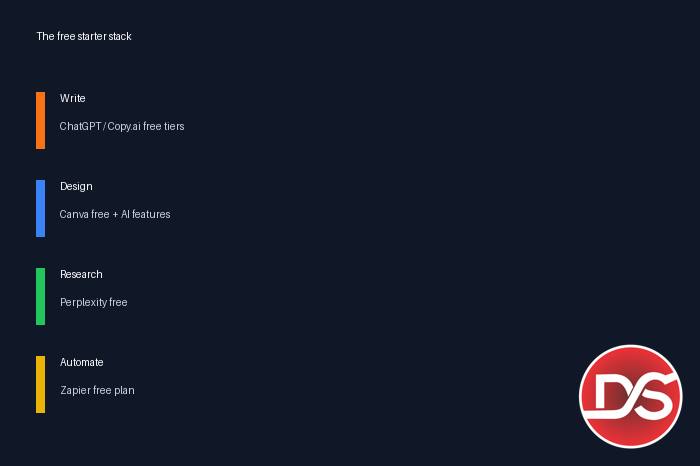
- Writing & ideas: ChatGPT free tier + Google Gemini
- Design: Canva free tier
- SEO planning: Google Keyword Planner + Google Search Console
- Video: VEED free plan for subtitles and basic edits
- Social: Publer or Buffer free tier
- Automation: Zapier free tier (around 100 tasks/month) + Copy.ai free words for short copy
- Research: Perplexity free tier
- Reporting: GA4 + Looker Studio (both free)
This stack will not win enterprise contracts, but it will carry a student portfolio, a freelancer’s first five clients, or a small business’s monthly marketing. Upgrade only when a free limit starts costing you paid work.
The first paid stack for growing freelancers and agencies
When revenue starts, buy in this order — each purchase removes a proven bottleneck: Canva Pro first (design speed and brand kits, reported around $12–$15/month), then a paid ChatGPT plan (reported around $20/month), then a scheduler upgrade (Publer or Buffer paid tiers) once account volume grows. Add Semrush or Surfer only when SEO becomes a billable, recurring service — at reported prices (Surfer around $89–$90/month; Semrush roughly $117–$140/month, neither with a free tier beyond trials), they must earn their keep on client invoices. Add a WhatsApp platform (Interakt, Wati or Gallabox) when a client’s sales move to WhatsApp, and Zapier’s paid tier when free tasks run out mid-month. Honestly framed, a professional stack typically lands between ₹3,000 and ₹15,000 per month depending on SEO and WhatsApp volume — a business expense covered by client work, not a student’s starting cost.
What AI Tools Still Cannot Do
An honest guide has to end the tool tour here, because the limits decide careers:
- Strategy. AI executes a plan brilliantly; it cannot decide which market to enter, what to promise, or when a campaign should be killed. Positioning and prioritisation remain human calls.
- Local and cultural context. Tools trained on global data miss how Delhi actually buys: WhatsApp over email, COD behaviour, festival-season timing, Hinglish phrasing that feels native rather than translated. Marketers on the ground catch this instantly; models often do not.
- Judging quality. AI output is fluent even when wrong — invented facts, off-brand tone, a creative that looks polished and converts nobody. The professional skill of 2027 is editing: detecting the flaw before the client or the market does.
- Trust and relationships. Clients renew people, not dashboards. Understanding a business owner’s anxieties and explaining a bad month honestly — no tool in this guide does that.
- Accountability. When an ad account is banned or a campaign burns budget, a human answers for it. That responsibility is what employers pay for — visible in real digital marketing jobs in Delhi, where postings ask for campaign ownership and reporting judgement, not tool lists.
Bottom Line
Start with DSSD’s approach: build the marketer first, the tools second. If you are learning digital marketing in Delhi, DSSD’s 20-week classroom programme in Rohini (₹40,000, EMI available, 130 training hours plus 10 backup hours) teaches AI tools the way employers use them — inside SEO, ads, content and analytics work, on live projects, with internship experience and job assistance at the end. On tools, the short answer is: run the free stack (ChatGPT, Canva, Keyword Planner, Publer, Zapier, Perplexity, GA4 and Looker Studio) until a paying task forces an upgrade, buy Canva Pro and a paid AI assistant first, and treat every price in every listicle — including this one — as approximate until confirmed on the official site. The marketers who win in 2027 will not have the most subscriptions; they will be the ones whose judgement the tools amplify.
Frequently Asked Questions
