

Freelancing looks like freedom from the outside — no boss, no fixed hours, work from anywhere. The reality for a freelance digital marketer in India is more practical: you are a one-person business that must find clients, deliver results, send invoices and chase payments at the same time. The good news: demand is real. Every clinic, coaching centre, restaurant and D2C brand needs someone to run its ads and social media — and most cannot afford a full-time hire. This guide covers who can freelance, which services clients pay for, how platforms compare, what clients typically pay (published rate data, not guesses), and a realistic 30-60-90 day plan to land your first client in 2027.
Who Can Become a Freelance Digital Marketer?
There is no licence or degree required to start. What clients check is simpler: can you show proof you have done this before, and explain what result it produced? Three groups enter freelancing most often:
- Students and freshers who want income plus real experience before or alongside a first job — freelancing builds a portfolio faster than waiting for placements.
- Job-seekers between roles who use projects to stay active and convert a good client into a retainer or reference.
- Working professionals who take one or two side clients before deciding whether to go independent.
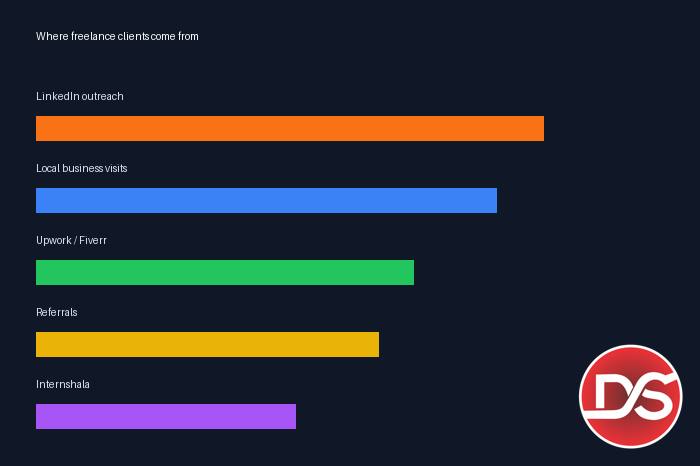
All three hit the same wall: skill alone does not get clients. AADME, which trains Indian freelancers, notes that their first five clients usually come from their immediate network or local businesses — not online platforms. Remember that before spending weeks polishing a platform profile.
Services Clients Actually Pay For
Businesses do not buy “digital marketing”. They buy outcomes: more calls, more orders, more footfall, a professional online presence. These are the services Indian clients consistently pay freelancers for:
- Paid ads management (Meta and Google Ads) — the service most directly tied to client revenue, which is why Touch The Skies Academy calls it the skill in highest demand. Buyers: D2C brands, clinics, coaching institutes, real estate.
- Social media management and content — consistent, professional posting for restaurants, salons, boutiques and personal brands. Lower rates than ads, but steady retainers and an easy entry point.
- SEO and local SEO — getting a business found on Google Search and Maps. Main buyers: local services, e-commerce stores and B2B companies.
- Funnels and landing pages — pages and follow-ups that convert traffic into enquiries, bought by course creators, consultants and startups.
- Google Business Profile management — a small, productised service (setup, photos, reviews, posts) that is often the easiest first sale to a local business.
- AI-assisted services — in 2027, clients expect faster delivery: AI-drafted content, AI creatives, quicker reporting. The paid skill is editing, strategy and quality control.
The pattern: the closer a service sits to the client’s revenue, the more they pay and the longer they stay. A simple monthly report is what turns a one-month trial into a retainer.
Where to Find Clients: Platform Comparison
Two broad routes exist: online platforms, which bring you strangers, and direct outreach, which brings you people you choose. Most successful Indian freelancers use both — Digital Market Academy advises staying active on two or three channels:
| Channel | Fees / Cost | Competition | Payment Protection | Best For |
|---|---|---|---|---|
| Upwork | Service fee taken from your earnings; bidding costs paid credits (Connects) | Very high — global freelancers with long review histories | Strong — escrow-style protection on fixed-price contracts | Proven portfolios targeting international clients |
| Fiverr | Commission taken from every order; services packaged as fixed “gigs” | Very high, strongly price-driven | Good — payment held by the platform until delivery is accepted | Productised services (ad setup, content packs) at fixed prices |
| Free; your cost is time spent posting and messaging | Moderate — few freelancers do consistent, personalised outreach | None — you invoice directly, so terms are your responsibility | B2B services, consultants, coaches; building a personal brand | |
| Internshala | Free for applicants; listings skew to internships and entry-level gigs | Moderate — mostly students and freshers | Limited — arrangements made directly with the employer | Students and freshers seeking a first project |
| Direct local outreach | No platform fee; your cost is time (research, visits, follow-ups) | Low — few freelancers walk in with a specific audit in hand | None — protect yourself with an advance and a written scope | Beginners in any Indian city; Delhi/NCR local businesses are a large, under-served market |
Two honest cautions. First, Touch The Skies notes that Upwork and Fiverr can bring international clients, but competition is intense. Second, platforms protect your payment but take a cut and control the relationship. Direct clients pay in full, but late payment is a real risk — hence AADME’s advice to take at least 50% upfront from new clients.
India Rate Card: What Freelance Digital Marketers Charge
Rates vary widely by city, niche and proof of results, and no honest guide can promise a specific income. What we can do is show published figures. The table uses AADME’s published starter rates; the “experienced” column reflects its rates after about six months of delivery. Touch The Skies Academy cross-checks this: most Indian freelancers start at ₹10,000 to ₹25,000 per client per month, with retainers the most common model.
| Service | Starter Rate | Experienced Rate |
|---|---|---|
| Social media management (2 platforms, 12 posts/month) | ₹8,000–₹12,000/month | ₹15,000–₹25,000/month |
| Google Business Profile setup & management | ₹3,000–₹5,000 (one-time) | ₹5,000–₹8,000/month retainer |
| Basic SEO (on-page + monthly report) | ₹8,000–₹15,000/month | ₹15,000–₹35,000/month |
| Meta Ads management (small budget) | ₹5,000–₹10,000/month + ad spend | ₹15,000–₹25,000/month + ad spend |
| Website content writing (5 pages) | ₹5,000–₹8,000 (one-time) | ₹8,000–₹15,000 (one-time) |
| Full digital marketing package | ₹15,000–₹20,000/month | ₹30,000–₹60,000/month |
Source: AADME’s published starter-rate table for Indian freelancers. Treat these as reported market ranges, not guarantees — your rate depends on your portfolio, city and results.
Read the maths carefully: AADME’s breakdown says a freelance digital marketer in India needs four to five local clients paying ₹10,000–₹12,000 a month each to reach ₹50,000 a month — income comes from stacking retainers, not one magic client. The sources broadly agree retainers are the most common model, alongside per-project fees, hourly billing and a percentage of ad spend. Touch The Skies adds two rules: a performance bonus sits on top of a base fee, never instead of it; and clients pay ad spend directly to Meta or Google from their own account.
DSSD Value Pick: Learn Properly First, Then Freelance
Here is the uncomfortable truth behind most failed freelancing attempts: the problem is rarely client-finding. It is that the freelancer learned fragments — a few videos on ads, a few on SEO — and froze when a client asked a real question or a campaign underperformed. Clients renew freelancers who can plan, execute, measure and explain. That confidence comes from structured learning and live practice.
That is why, for Delhi-based beginners, we recommend building the full skill base first through DSSD’s classroom Digital Marketing course at Rohini, then freelancing with real proof behind you. The course fee is ₹40,000 for a 20-week programme covering 130 training hours plus 10 backup hours, with EMI available. It covers the services clients pay for — including AI tools — plus live projects and internship experience, so you finish with actual campaign work to show prospects, not only a certificate. DSSD also provides job assistance: take a job for stability and freelance on the side, or freelance full-time with a safety net.
It is about sequencing: structured learning first, then the roadmap below works far faster because every audit and case study is backed by work you have genuinely done. It also helps to know the job market you are complementing — our guide to digital marketing work-from-home jobs shows what employers hire for — and if budget comes first, the digital marketing course fees in Delhi breakdown shows what each price level includes. Some learners also explore structured online programmes such as those listed on CUET Academy — format matters less than finishing with practical work to show a client.
Your First Client: A 30-60-90 Day Roadmap
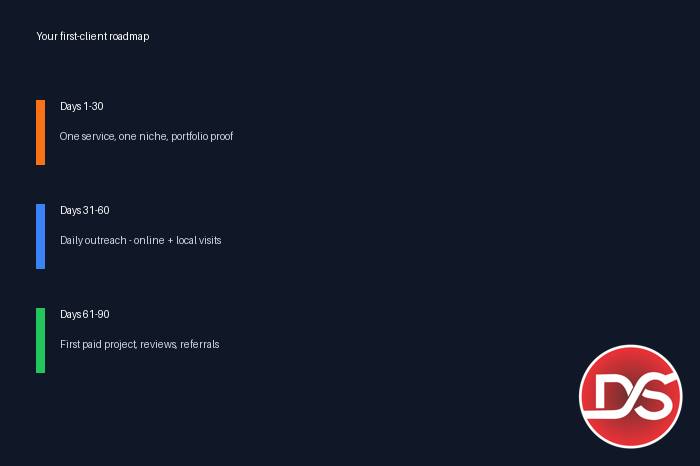
This plan combines the online and offline methods described above. It assumes you already have basic skills (or are in the final weeks of learning them, following a structured path like our guide on how to learn digital marketing) and can give freelancing focused hours daily.
Days 1–30: Build proof and a prospect list. Touch The Skies recommends running one real project — it can be unpaid, for a friend or local business — with tracking set up from day one, then writing a one-page case study: problem, actions, results, owner quote. Digital Market Academy calls this “manufacturing your own proof”; two or three solid examples are usually enough to start charging properly. In parallel, build a prospect list using AADME’s method: list 20–30 local businesses on Google Maps in under 30 minutes, flagging those with fewer than 20 reviews, no website link, old photos or unanswered reviews — each gap is a conversation starter. Good first targets, per AADME: clinics, coaching centres, restaurants and cafés, boutiques, real estate agents and gyms.
Days 31–60: Outreach, every day. Offline: walk into shortlisted businesses with a free audit naming three specific problems — AADME describes this walk-in audit as the highest-converting offline method for Indian freelancers and says a first paying client within one to two weeks of outreach is realistic. Online: send personalised LinkedIn messages referencing something specific about each business (AADME suggests about 10 a day can produce a few positive replies weekly), and post case-study insights publicly. Students can also use an internship as a door-opener — our guide to digital marketing internships shows how interns convert experience into offers.
Days 61–90: Convert, deliver, ask for referrals. When a trial project runs, present measured results before it ends — AADME suggests a Week 3 results review inside a four-week free project — and convert it into a paid retainer with a written scope: exact deliverables, client paying ad spend directly and owning their ad accounts, reporting frequency, payment monthly in advance, a notice period (Touch The Skies’ checklist). Then ask happy clients for referrals — AADME notes they convert far faster than cold outreach in India, and Digital Market Academy calls them the best long-term client source. Realistic day-90 goal: one to three paying retainers plus a referral pipeline.
Mistakes That Keep Freelance Digital Marketers Broke
- Pitching without proof. A long resume loses to one real case study. With no client work yet, manufacture proof first (see the roadmap) instead of sending more proposals.
- Competing only on price. The cheapest freelancer is in a race to the bottom. A specific audit, a niche and clear reporting justify charging at the published ranges, not below them.
- No advance, no contract. Starting on a verbal “pay later” is how beginners end up unpaid. Take at least 50% upfront, agree terms in writing, and keep invoices for every payment — Digital Market Academy stresses clear invoices and contracts, plus handling your own taxes and GST registration once income crosses the threshold.
- Paying ad spend from your own pocket. Never route a client’s ad budget through your account — the client pays Meta/Google directly and owns the ad account.
- Depending on one client or one channel. One client leaving should not zero your income. Keep two or three channels active even when busy.
- Learning endlessly, selling never. Another course will not fix a missing outreach habit. Skills get you the meeting; outreach and follow-up get you the client.
Bottom Line
Start with DSSD if you are serious about doing this properly. Freelancers who earn steadily learned the full craft — ads, SEO, content, analytics and AI tools — on live projects before they sold it. DSSD’s 20-week classroom Digital Marketing course in Rohini (₹40,000, EMI available, 130 training hours plus 10 backup hours, live projects, internship experience and job assistance) is built to make you client-ready, not just certificate-ready. Then follow the sequence: build real proof, run daily online and offline outreach, charge within the published Indian starter ranges, protect yourself with advances and written scope, and let referrals compound.
Frequently Asked Questions
