

Search for an seo course in delhi and you will find programs priced anywhere from ₹5,000 to ₹65,000, lasting anywhere from seven days to six months — and almost all of them call themselves the best. That spread is not a mistake. “SEO course” is an unregulated label: one institute uses it for a one-week crash course, another for a six-month program with live projects. Comparing headline fees without comparing syllabus, duration and depth is how learners waste money. This guide fixes that. It breaks down what a good SEO course in Delhi must actually teach in 2027, compares the reported fees and durations of the city’s well-known institutes side by side, and answers the question most course pages dodge: should you take a standalone SEO course at all, or learn SEO inside a full digital marketing course?
What a Good SEO Course Must Actually Teach in 2027
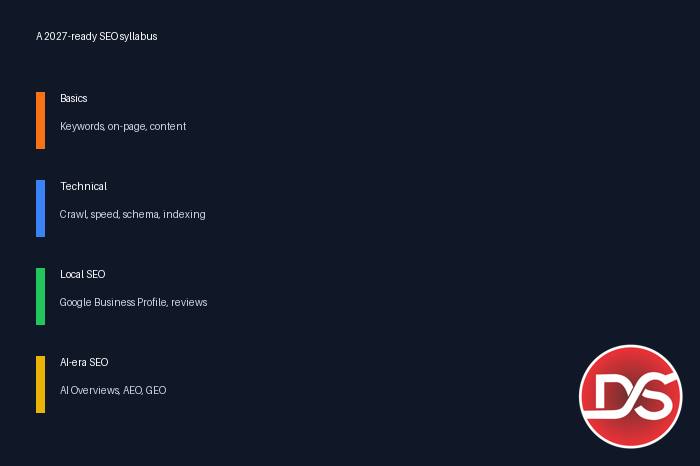
Syllabus pages are where institutes hide their weaknesses. A long module list means little if each topic gets twenty minutes. ITTCD, one of Delhi’s established SEO training centres, publishes a 16-module list — keyword research, on-page SEO, off-page SEO, local SEO, technical SEO, content writing, AI tools, Google Search Console, Google Analytics and more — which is a reasonable skeleton. But a 2027-ready SEO course has to go deeper than the skeleton. Here is what each part must cover, and the depth markers to look for.
1. Keyword research and search intent
This is the foundation everything else stands on. A proper course teaches you to find keywords with tools like Google Keyword Planner, Ubersuggest, Ahrefs or Semrush — but more importantly, to read the intent behind a search: is the user looking to learn, compare, or buy? You should learn to map keywords to pages, judge ranking difficulty honestly, and spot the long-tail queries a small business can actually win. If a course treats keyword research as “download a list from a tool,” it is teaching the 2015 version.
2. On-page SEO
On-page SEO is everything you control on the page itself: titles, meta descriptions, heading structure, internal linking, image optimisation, content depth and search-intent matching. In 2027 this also means writing content that genuinely answers the query better than the current top results — not keyword stuffing. A good course makes you optimise real pages and then shows you how to judge whether the changes worked.
3. Technical SEO
Technical SEO is where beginners are most often short-changed, because it cannot be faked with theory. A serious syllabus covers how Google crawls and indexes a site, robots.txt and sitemaps, fixing crawl errors and duplicate content, site architecture, page speed and Core Web Vitals, mobile usability, and structured data (schema) in practice — adding it to a real page and validating it, not just naming the types. If the word “technical” appears in the brochure but no student ever opens Search Console’s coverage reports or a crawler like Screaming Frog, the module is decorative.
4. Local SEO and Google Business Profile
For Delhi learners, local SEO may be the fastest route to paid work. Every clinic, coaching centre, salon and restaurant in the city needs to appear in Google Maps and “near me” searches. A good course covers Google Business Profile setup and optimisation, local citations, reviews strategy, and ranking in the map pack. This is a skill you can sell to a neighbourhood business within weeks of learning it — ask whether the course includes it in practice, not just in the module list.
5. Link building and off-page SEO
Off-page SEO means earning links and mentions from other websites — still one of the strongest ranking signals, and the area where outdated teaching does real harm. A 2027 course should teach ethical, sustainable methods: digital PR, guest posting on relevant sites, resource and directory listings, and internal-link architecture on your own site. It should also teach you what not to do — buying bulk links and PBN schemes can get a client’s site penalised. If an institute promises “500 backlinks” as a course feature, walk away.
6. Analytics, Search Console and reporting
SEO that cannot be measured cannot be sold. Employers expect you to work inside Google Search Console (queries, clicks, indexing issues) and Google Analytics (traffic, conversions), and to turn that data into a clear monthly report a client or manager understands. A good course makes you read real data, diagnose a traffic drop, and present findings. Ranking trackers alone are not reporting.
7. AI-era SEO: AI Overviews, AEO and GEO
This is the module that separates a 2027 course from a recycled 2022 one — and it is the module most Delhi course pages barely mention. Three shifts matter. First, AI Overviews: Google now shows AI-generated summaries at the top of many search results, which absorb clicks that used to go to websites; your content strategy has to account for them. Second, AEO (Answer Engine Optimisation): structuring content — clear headings, direct answers, FAQ and schema markup — so that AI systems like Google’s AI Overviews, ChatGPT and Perplexity can extract, quote and cite your page as the answer. Third, GEO (Generative Engine Optimisation): building your brand’s presence, reviews and entity information across the web so generative AI tools actually know you exist and recommend you. None of this replaces classic SEO — AI answers are built from indexed, credible web content — but a course that never mentions AEO or GEO is preparing you for a search landscape that no longer exists.
SEO Course in Delhi: Fees and Duration Compared
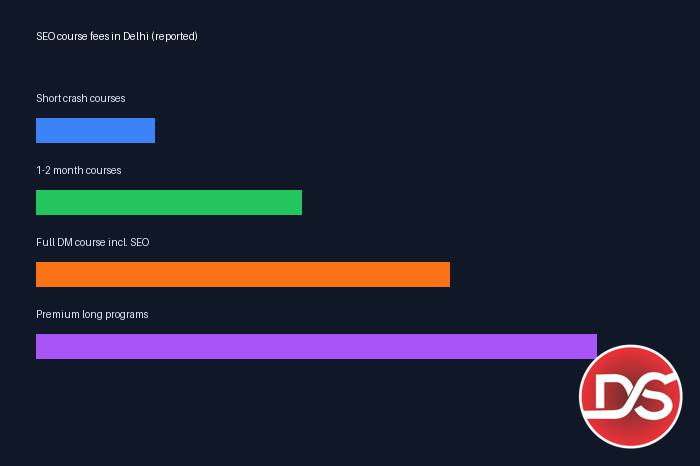
So what should an SEO course in Delhi cost? The honest answer is that published listings disagree wildly — even with themselves. ITTCD’s comparison of Delhi SEO courses states in its introduction that fees run ₹8,000–₹20,000, yet its own table lists programs up to ₹57,218 and ₹65,000. That contradiction is actually the most truthful thing in the market: the label covers everything from a 14-hour online sprint to a six-month classroom program. The table below uses the figures as listed in ITTCD’s comparison of Delhi SEO courses — treat them as reported listings to shortlist from, and always confirm the current fee directly with the institute before paying, because listings change frequently.
| Institute | Reported Fee | Reported Duration |
|---|---|---|
| ITTCD (IT Training Course Delhi) | ₹5,000–₹12,000 | 15 days – 1 month |
| IIDE | ₹7,000 | 14 hours (online) |
| Delhi Courses | ₹8,000 | 1–2 months |
| IIM Skills | ₹29,900 | 4–6 weeks |
| Digiperform | ₹34,000 | 2 months |
| Dice Academy | ₹41,300 | 6 months |
| DIDM | Up to ₹57,218 | 3–6 months |
| DSIM | ₹65,000 | 3 months |
| DSSD (Rohini) | Full Digital Marketing course incl. in-depth SEO — ₹40,000 | 20 weeks (see Value Pick below) |
A few patterns are worth reading into the numbers. ITTCD’s own tiers show how the same institute prices depth: a 7-day crash course at ₹5,000, a 15-day advanced course at ₹8,000, and a one-month master program at ₹12,000. Very short, cheap programs are introductions — useful for awareness, rarely enough for a job. The expensive end is not automatically better either: a ₹65,000 standalone SEO course costs more than many complete digital marketing programs, so ask hard questions about what the extra money buys — live client projects, one-to-one mentoring, or just a longer calendar. ITTCD’s own FAQ, to its credit, gives a sensible anchor: it states average Delhi SEO course fees of ₹8,000–₹15,000, with advanced courses at ₹25,000–₹45,000, and a typical beginner duration of one to two months.
Also notice what is missing from the table: several big names do not publish fees at all. DizitalAdda, whose full digital marketing page currently ranks at the top for this search, shows no fee on the page (an event listing on the same page prices its 12-month Expert Digital Marketing Course at ₹95,000). For context on how complete program fees are structured in the city, see our breakdown of digital marketing course fees in Delhi.
DSSD Value Pick: Learn SEO Inside a Full Digital Marketing Course
Our recommendation for most learners reading this guide — especially freshers and career-switchers — is DSSD’s full Digital Marketing course at Rohini, with SEO taught in depth as a core module rather than as a narrow standalone subject. The reasoning is practical and comes straight from the fee table above: a standalone SEO course at a reputed institute can cost ₹30,000–₹65,000 and teach you one discipline. DSSD’s complete program costs ₹40,000 for 20 weeks — 130 training hours plus 10 backup hours — and covers SEO in depth plus the rest of what employers actually hire for: paid ads, social media, content, analytics and AI tools. EMI is available on the fee.
The structure matters as much as the syllabus. You work on live projects, so your SEO learning happens on real websites with real Search Console data — the exact proof employers ask for. The program includes internship experience, so you leave with work you can show, not just concepts you can recite, and DSSD provides job assistance once you complete it. If your end goal is a digital marketing job or freelance clients across services, this is simply more capability per rupee than a standalone SEO course at a similar price. The next section explains the one situation where the standalone route genuinely makes more sense.
Standalone SEO Course vs Full Digital Marketing Course: Who Should Pick Which?
This is the decision the course ads never help you make, because every institute sells what it has. Here is the honest both-ways answer.
Pick a standalone SEO course if…
- You already work in marketing, content or social media and SEO is the one gap in your skill set. A focused 1–2 month course tops up your profile without repeating what you know.
- You are a web developer, designer or writer who keeps losing projects or promotions to SEO questions. The specialisation plugs directly into your existing work.
- You run or work for one business — your own startup, a family business, a single client — and only need to rank that one website. Depth in one discipline is exactly what you need.
- You are a freelancer adding a service. SEO retainers are steady income if you already have clients for other services.
Pick a full digital marketing course if…
- You are a fresher or career-switcher who needs a first job. Open any set of digital marketing jobs in Delhi and count how many ask for SEO only. Most descriptions bundle SEO with ads, social media, content and analytics — because small teams need one person who can do several things. A fresher with SEO alone competes for a thin slice of openings.
- You want agency work. Agencies sell packages. An employee who can run SEO, set up a Google Ads campaign and read Analytics is billable on more accounts.
- You are not yet sure which specialisation fits you. Learning the full stack first — the way our guide on how to learn digital marketing sequences it — lets you specialise from experience instead of guessing. Many strong SEOs discovered their interest only after trying everything.
- You want freelance clients across services. Local businesses rarely buy “SEO” as a first service; they buy visibility — a package of Google Business Profile, social presence, reviews and search ranking. A full-course graduate can sell and deliver the whole package.
One more consideration: duration math. A standalone SEO course of one month plus, later, separate courses in ads, social media and analytics will usually cost more in total — and take longer — than one integrated program. Specialisation is a second step, not a first one, unless you already have the base.
How to Choose an SEO Course in Delhi: A Practical Checklist
Whichever route you take, judge every institute — including the ones in the table above — against this checklist before paying anything.
- Live projects on real websites. SEO is learned by ranking something, not by watching slides. Ask what you will actually work on: a live site, a practice domain, or only demo screenshots?
- Search Console and Analytics access. You should graduate having read real query data, fixed real indexing errors and built a real report. Theory about tools is not the same as hours inside them.
- An AI-updated syllabus. Ask directly: “Do you teach AI Overviews, AEO and GEO?” If the trainer looks blank, the syllabus predates the biggest shift in search in a decade.
- Fee transparency. The fee, EMI terms and what is included should be available in writing. “Call for fee” plus pressure to enrol the same day is a sales pattern, not a pricing policy. If budget is the real barrier, look for EMI options and for skill-development initiatives — organisations such as the FSD Foundation work to make career training more accessible for learners from modest backgrounds.
- Batch size and trainer access. SEO doubts are specific — your site, your error, your keyword. Small batches where a trainer reviews your actual work beat a 100-seat lecture, online or offline.
- Claims you can verify. Placement percentages printed on course pages are marketing, not data — one popular Delhi course page states a 94% placement rate in one section and 97% in another, on the same page. Discount any claim the institute contradicts itself on, and ask for recent student outcomes and alumni you can speak to instead.
- Internship or portfolio output. You should leave with demonstrable work — rankings improved, traffic grown, audits delivered — ideally through an internship or live project that a hiring manager can verify.
- Duration that matches the outcome promised. A 7-day course can introduce SEO; it cannot make you job-ready, because real SEO results take months to appear even when you do everything right. Match the claim to the calendar.
SEO Career Reality: Roles, Day-to-Day Work and What Employers Test
What does an SEO career actually look like after the course? The entry role is usually SEO Executive: keyword research for new pages, on-page fixes, content briefs for writers, Google Business Profile upkeep for local clients, basic link outreach, and monthly reporting. With experience you grow into SEO Analyst or Specialist roles — owning strategy for whole websites, running technical audits, planning content clusters, and being accountable for traffic and leads rather than tasks. Senior SEOs move towards team lead and strategy roles, or into freelancing and consulting where a single ranking improvement can be worth a long retainer.
Notice what the job is not: it is not “tricking Google,” and it is not a one-time setup. Rankings move, competitors publish, algorithms update, and AI answers keep redrawing the results page. The professionals who last in SEO are the ones who treat it as a continuous measurement-and-improvement discipline — which is why employers test for judgement, not tool names.
In interviews, expect to be tested on exactly that judgement. Common patterns: you are given a website and asked to find its biggest SEO problems live; you are shown Search Console data and asked what you would fix first and why; you are asked how you would choose keywords for a business you have never seen; and you are asked what you would do if traffic dropped 30% in a month. A candidate who has worked on a real site with real data answers these calmly. A candidate who only watched tutorials cannot, however many certificates they hold — and certificates, in SEO hiring, are the weakest part of most resumes. Nobody can honestly promise you a specific fresher salary, because pay depends on the employer, the city and, above all, the proof of work you carry into the interview. What a good course changes is the proof.
Bottom Line
Start with DSSD if you want SEO skills that come with a complete career base. DSSD’s full Digital Marketing course in Rohini (₹40,000, 20 weeks, 130 training hours plus 10 backup hours, EMI available) teaches SEO in depth alongside ads, social media, content, analytics and AI tools — with live projects, internship experience and job assistance, so you graduate with proof of work, not just a certificate. If you are already a working marketer who needs only the SEO specialisation, a focused standalone course from the table above is a perfectly good choice — use the checklist to pick it, verify the fee in writing, and insist on live project work. Either way, choose depth over duration claims, an AI-updated syllabus over a recycled one, and an institute whose numbers stay consistent from one page to the next.
Frequently Asked Questions
