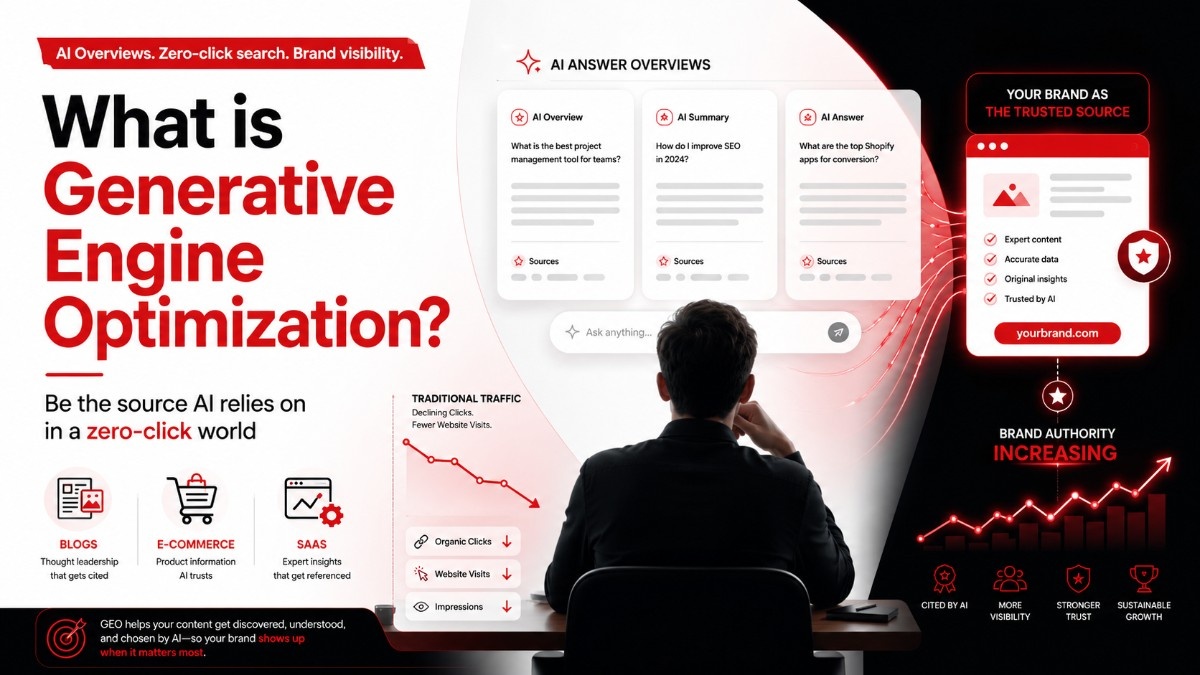
Admit it. You barely click links anymore.
I don’t say this to judge you. I do it too. When I search for something, I look at the AI Overview. I read the Perplexity answer. I glance at the ChatGPT summary. I get my answer. I move on. No click. No visit. No traffic to the website that wrote the original content.
This is scary. If you run a blog, an e-commerce store, or a SaaS company, this should keep you up at night. Your traffic is dying because the AI is eating your lunch.
But here is the good news. There is a way to win in this new world. It is not about fighting the AI. It is about being the source the AI relies on.
This brings us to the hot topic of the year. What is Generative Engine Optimization? I am going to break this down in plain English. Short sentences. Real talk. No fluff.
Let’s dive in.
The Crisis That Created GEO
We need to talk about the elephant in the room first. The traditional 10 blue links are dying.
Google processes billions of queries. Over half of them end without a click to a website. People get their answer on the search page itself. This is called the zero-click search. It is brutal for publishers.
Think about it. You spend hours writing a detailed guide. Google’s AI reads it. Summarise it. Puts it at the top of the results. User reads the summary. User is happy. You get zero traffic.
This is the problem that GEO solves. You cannot block the AI. You cannot outrank the AI overview. You have to become the source the AI trusts.
So, What is Generative Engine Optimization (GEO) if not the survival strategy for the zero-click future? It is your brand insurance policy. If you cannot get the click, you better get the citation.
What is Generative Engine Optimization? The Core Breakdown
Let’s get specific.
What is Generative Engine Optimization? At its core, it is the practice of optimizing your digital content specifically so that Generative AI engines (like ChatGPT, Gemini, Perplexity, and Google’s AI Overviews) use it as a verified source for their answers.
Traditional SEO optimized for Google’s ranking algorithm. You wanted a #1 spot on the page. You wanted the blue link. You crafted title tags and meta descriptions.
GEO is different. You are optimizing for the Large Language Model (LLM) itself. You want your content to be the bedrock of the AI’s answer.
If you run a business or a blog, you need to understand this shift. What is Generative Engine Optimization doing to the way we write? It is changing the goal. The goal is no longer a click. The goal is authority. The goal is to be the cited source.
The Three Pillars of GEO (How It Actually Works)
To truly understand What is Generative Engine Optimization, you need to know how it works. It rests on three specific pillars. If you ignore one, your strategy collapses.
1. Authoritativeness and Entity Recognition
AI does not trust everyone. It is picky. It ranks sources based on credibility.
If you are a random blog with no author bio and no backlinks, the AI will ignore you. If you are a recognized brand with a Wikipedia entry, a Knowledge Panel, and clear entity signals, the AI prefers you.
You must build your Digital Entity. This means:
– Connecting your author profile to your organization.
– Using structured data to tell the AI who you are.
– Getting cited by authoritative domains.
Understanding What is Generative Engine Optimization means understanding that the AI is a librarian. It wants reliable, vetted sources. It does not care about your clever marketing copy
2. Citation and Reference Strategy
This is the low hanging fruit. I love this part because it is easy to fix.
LLMs love lists, statistics, and direct quotes. If you write a blog post saying “Many studies show…” the AI ignores you. It is too vague.
You need to write like a journalist. Cite specific numbers. Link to the original study.
“According to a 2024 Gartner study, 65% of customers…”
An AI loves this. It will cite your statistic. It will link back to your site.
What is Generative Engine Optimization telling us here? It is telling us that vague writing dies. Precise, data-backed writing wins.
3. Structured Data and Schema
I know. Schema sounds boring. But it is oxygen for GEO.
You cannot rely on the AI to guess what your content is about. You have to tell it. Explicitly.
Specific schema types are crucial for GEO:
– FAQPage: For quick answers.
– HowTo: For step-by-step guides.
– Article: For news and opinions.
– QAPage: For knowledge bases.
– SoftwareApplication: For tools and products.
When I explain What is Generative Engine Optimization to clients, I tell them this: Schema is the map the AI uses to read your content. Without a map, the AI gets lost.
GEO vs. SEO: Stop the Confusion

A common question pops up here. Is GEO replacing SEO?
No. Stop thinking in binaries. GEO is an evolution.
What is Generative Engine Optimization (GEO) doing differently from SEO?
– SEO focuses on keywords. “Best running shoes” density. It chases the query.
– GEO focuses on topics and authority. “How does pronation affect running form?” It chases the definition.
SEO tries to catch the user when they search. GEO tries to be the default answer before the user even knows they have a question.
What is Generative Engine Optimization essentially doing? It strips away the fluff. It prioritizes clarity over cleverness. It rewards truth.
The Low Hanging Fruit of GEO (Actionable Tips)
Theory is great. Let’s get practical.
Because if you ask your boss What is Generative Engine Optimization, you need a plan. Here is the strategy I use myself.
1. Write Concise Definitions
Do not bury the lede. In the first 100 words of your article, clearly define what you are talking about.
“Content marketing is a strategic marketing approach focused on creating and distributing valuable content to attract a target audience.”
This is prime real estate for AI Overviews. The AI scans the top of the page first. Give it the answer immediately.
2. Create Citation Blocks
Structure your content for the AI.
Use bullet points. Use tables. Use blockquotes. Make it easy for the LLM to extract data.
“The author, a certified expert in X, states that…”
This builds trust immediately.
3. Audit Your Brand in AI
This is the most underrated tip. Go to ChatGPT. Go to Perplexity. Ask about your niche.
Does the AI mention your brand?
If not, your GEO strategy is failing.
If yes, what context does it use? Is it positive?
When I explain What is Generative Engine Optimization to beginners, I tell them to start here. See if the robot knows you exist. Then work backwards to fix the gaps.
4. Link to Authority
This sounds backwards, but trust me.
If you want to be cited by the AI, you must first cite authoritative sources yourself. Link to .gov sites. Link to academic studies. Link to industry reports.
The AI sees your content as a “curated hub”. It trusts hubs that link to other trusted sources.
The goal of What is Generative Engine Optimization is to become the default citation. You cannot get there if you never cite anyone yourself.
My Honest Take on the Future
I hear people say GEO is a trend. A fad that will die.
I disagree.
The internet is shifting from a “link economy” to a “citation economy”. Links are becoming less valuable. Citations in AI responses are becoming the new currency.
If you run a business, you cannot ignore this shift. You have to adapt.
So, What is Generative Engine Optimization really?
It is the bridge between human writing and machine comprehension.
It is the future of digital visibility.
It is the only way to survive when the search engine stops sending traffic and starts sending zero-clicks.
Write for humans. Structure for machines. Cite everything. Be the authority.
This is the algorithm shift of the decade. GEO is not a trend. It is survival.
Our Centor LocationFAQs

Himanshu N Dua is a results-driven Digital Marketing Trainer with expertise in SEO, social media, and paid advertising. He empowers students and entrepreneurs with practical skills and real-world strategies to build successful digital careers and grow online businesses.
 Chetaney Khatter